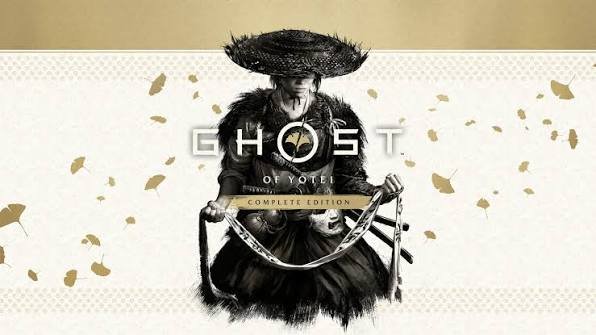
Revenge is a familiar starting point for samurai stories, but what makes Ghost of Yōtei compelling is the question of what happens when revenge becomes the only thing keeping someone moving forward. Sucker Punch Productions built its sequel around Atsu, a mercenary whose pursuit of the Yōtei Six is driven by the murder of her family. It is a brutal premise, but one that gives the adventure a more personal edge than a straightforward tale of reclaiming territory or restoring a fallen clan.
AT A GLANCE
Developer: Sucker Punch Productions
Publisher: Sony Interactive Entertainment
Genre: Action-Adventure
Platform: PS5
Release date: October 1, 2026
Ghost of Yōtei: Complete Edition arrives on PS5 with the full original game, Echoes of Sekigahara, a new story expansion that explores another part of Atsu’s past, and Most Wanted, a combat survival mode that puts the game’s swordplay at the centre of the experience. The package also includes a selection of cosmetic items and bonuses associated with the Digital Deluxe Edition.
What makes this edition worth examining is that the additions approach Ghost of Yōtei from two different directions. Echoes of Sekigahara expands Atsu’s character and adds another narrative chapter, while Most Wanted strips away much of the open-world structure and asks a simpler question: how well do you actually understand the combat system?
That is a sensible combination. The original game had a strong foundation in its swordplay, exploration and cinematic presentation, but even a beautiful open world can lose some of its appeal when its activities begin to feel familiar. An additional story can provide a reason to return, while a focused combat mode can make the game’s best mechanics feel fresh again.
The Complete Edition is therefore more than a cosmetic re-release. It brings together the original adventure and two substantial additions that serve different purposes. The question is whether they deepen an already satisfying experience or simply give players more opportunities to repeat what they have done before.
Story
The original Ghost of Yōtei is built around a straightforward premise: Atsu returns to the place where her family was murdered and sets out to kill the six men responsible. What gives the story its emotional weight is not the list of targets itself, but the person Atsu becomes while pursuing them. She is capable, ruthless and often frighteningly determined, yet the violence driving her forward also threatens to consume whatever remains of her life beyond revenge.
I found this a more interesting foundation than a conventional tale of honour and samurai duty. Atsu is not simply trying to restore an established order. She exists on its margins, moving between communities, accepting work and forming relationships that complicate her otherwise singular purpose. The story is at its strongest when these encounters force her to confront the difference between surviving through violence and actually finding a reason to live.
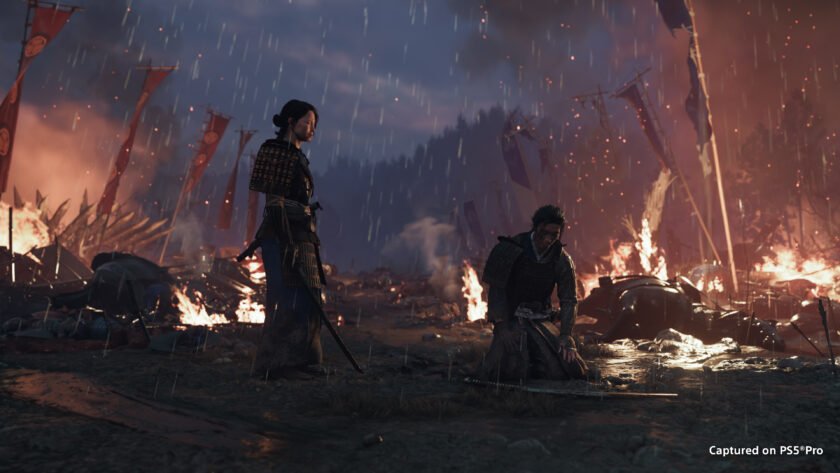
The six targets give the main campaign a clear structure, but they also create a potential weakness. With a list of people to hunt down, the narrative can occasionally feel like a sequence of individual vendettas rather than a continuously developing drama. The supporting characters and smaller stories help offset that repetition, although not every encounter carries the same emotional weight.
What I appreciate about the main campaign is that Atsu’s personality gives the familiar revenge narrative some bite. She is not a conventional heroic samurai, and her willingness to use fear and brutality makes her journey more complicated than a simple struggle between good and evil. The story also benefits from the contrast between her violent objective and the beauty of the land she travels through. There is a constant tension between the life she could have had and the one she has chosen to pursue.
Echoes of Sekigahara
The new Echoes of Sekigahara expansion adds another chapter to Atsu’s story, introducing Nagato, a figure from her past who reappears in Ezo. Their encounter takes Atsu into the Ashoro Foothills, a new explorable region associated with the Snake and his loyal followers, the Vipers. The narrative also revisits Atsu’s experiences during the Battle of Sekigahara through flashbacks, shedding light on her life before the events of the main game.
The relationship between Atsu and Nagato is the expansion’s most interesting element. The original campaign establishes Atsu as a person shaped by trauma, but there is still room to explore the experiences and relationships that existed before her pursuit of the Yōtei Six became her defining purpose. Nagato provides that opportunity, offering a different perspective on her personality and the choices she has made.
I like the decision to connect the present-day story with Atsu’s past rather than introducing an entirely unrelated threat. A revenge narrative can only go so far by adding another antagonist. Examining the relationships that shaped the protagonist is a more meaningful way to expand the story, especially when those memories complicate our understanding of her.
The Battle of Sekigahara flashbacks are also a welcome addition, although the expansion spends considerably more time in the present than its premise might suggest. Players expecting a campaign evenly divided between historical flashbacks and present-day exploration may find that balance disappointing. The flashbacks work best as context for Atsu’s relationship with Nagato rather than as a substantial second campaign.
The new region provides a familiar mixture of exploration, side quests, bounty hunting and combat. It feels like a natural extension of the main game, but that familiarity is both its strength and its weakness. The landscape offers another beautiful place to explore, yet the activities rarely depart dramatically from the established formula.
The expansion’s placement in the main narrative is also worth considering. Echoes of Sekigahara takes place before the conclusion of the original campaign, rather than functioning as a straightforward continuation after its ending. Returning players who completed Atsu’s journey long ago may need a moment to adjust to the story’s chronology.
Ultimately, Echoes of Sekigahara works because it adds context to Atsu rather than simply giving her another list of people to kill. Its story is a worthwhile addition, even if the familiar structure and limited use of flashbacks prevent it from becoming an essential new chapter for every returning player.
Gameplay
Ghost of Yōtei’s combat is its greatest strength. Sword fights have a deliberate rhythm, with success depending on recognising enemy attacks, choosing the right response and knowing when to commit to an opening. It is not simply about chaining attacks together until an opponent falls. A poorly timed strike can leave Atsu exposed, while a well-executed parry can turn a dangerous encounter around in seconds.
The weapon system is particularly effective because it encourages players to adapt rather than settle into one universal fighting style. Different weapons are suited to different enemy types, and switching between them makes combat feel more involved than a basic light-attack and heavy-attack routine. Once the mechanics begin to click, fights become satisfying exchanges of timing and judgement.
The original game’s stealth mechanics provide a useful alternative. Atsu can approach an enemy camp cautiously, remove isolated guards and reduce the opposition before a direct confrontation begins. Alternatively, she can charge into the open and rely on her skill with a blade. Neither approach is always appropriate, which makes assessing an encounter part of the appeal.
There are moments when the system feels more restrictive than it should. The emphasis on weapon matchups can interrupt the flow of combat when several enemy types surround Atsu, and encounters sometimes become a matter of responding to the correct visual cues rather than improvising. Still, the underlying swordplay is strong enough that these frustrations rarely undermine the entire experience.
Echoes of Sekigahara’s new additions
The expansion introduces heavy weapons, including powerful clubs and hammers that can inflict considerable damage but break after a limited number of heavy blows. They add a satisfying sense of brute force to combat, although their limited durability means they are not a replacement for Atsu’s established arsenal. The expansion also introduces new enemies, armour sets and other equipment, but its combat encounters remain largely familiar.
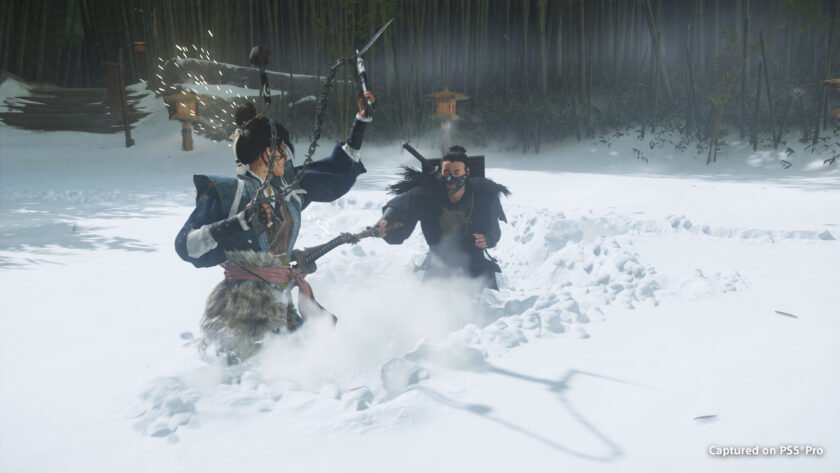
That is my main reservation about the story expansion. The new equipment gives returning players something to experiment with, but it does not fundamentally change how the game is played. Experienced players will recognise many of the same encounter structures and enemy behaviours from the original campaign.
The Ashoro Foothills also follow a familiar open-world pattern. There are places to explore, enemies to hunt and activities to complete, all of which fit comfortably into Ghost of Yōtei’s existing design. The problem is not that these activities are poorly executed. It is that the expansion rarely finds a compelling reason to make them feel fundamentally different.
Most Wanted
Most Wanted is the more exciting addition because it puts the combat system front and centre. Rather than travelling across an open world and deciding which activity to pursue, players accept bounties and enter runs built around successive combat encounters. Defeating enemies unlocks perks that can change a run’s direction, while further progression introduces new playable characters and rewards.
I think this is a particularly good fit for Ghost of Yōtei. The main campaign occasionally asks players to travel considerable distances between encounters, and even enjoyable combat can lose some of its impact when surrounded by lengthy stretches of exploration. Most Wanted removes that distraction. It gives players a direct route into the game’s strongest mechanic.
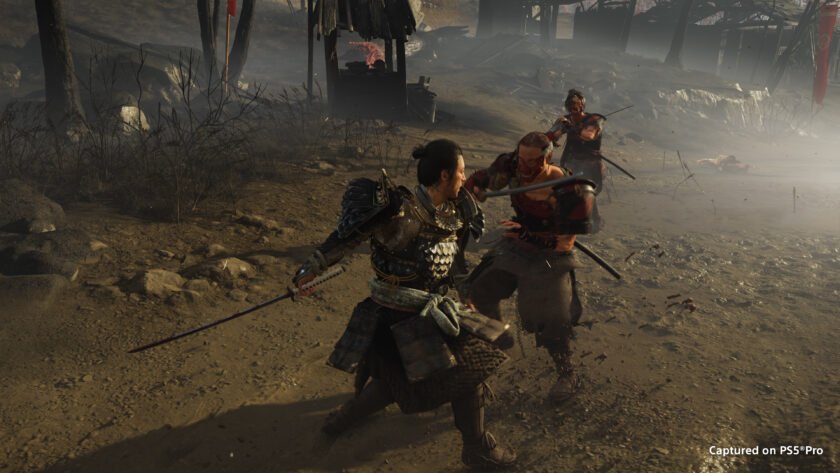
The roguelike structure adds an element of experimentation that the main campaign does not always encourage. Choosing perks during a run lets players build around different strengths, whether that means improving offensive capabilities, strengthening survivability or making better use of particular weapons. Because each run develops differently, there is a reason to keep playing beyond simply completing another mission.
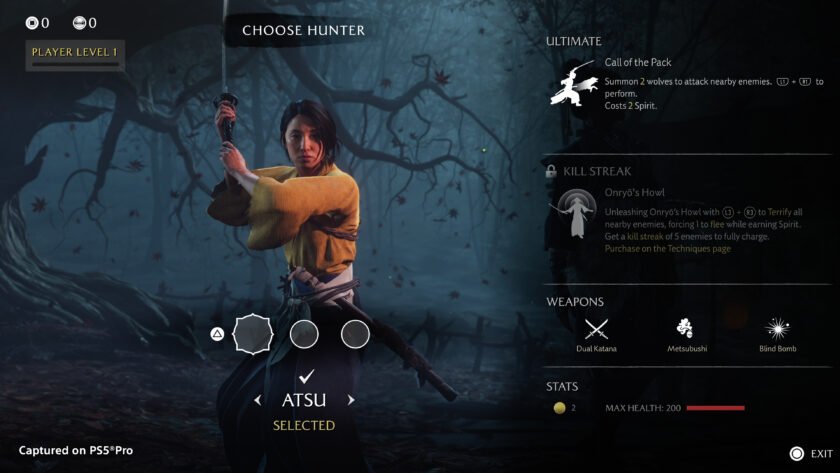
The additional playable characters also help. Atsu is no longer the only option, and characters such as Oyuki and Nagato bring their own weapons and combat approaches. The inclusion of Jin Sakai from Ghost of Tsushima is a particularly enjoyable callback, though his appearance is best treated as a bonus rather than the mode’s main attraction.
Most Wanted is not without limitations. Repeated combat encounters can become predictable, and a roguelike mode naturally relies on players being willing to replay content to unlock more rewards. If the core swordplay does not appeal to you, the structure will not magically change that. But for players who enjoy mastering the combat system, this is a much more substantial addition than another collection of map icons.
Ghost of Yōtei Legends
The Complete Edition also includes Ghost of Yōtei Legends, the online cooperative mode for up to four players. It offers multiplayer activities built around supernatural versions of the Yōtei Six, with modes including Survival, Story and Incursion. Online play requires a PlayStation Plus subscription.
Legends expands the game’s appeal beyond the single-player campaign. Its supernatural encounters and cooperative structure provide a different challenge from Atsu’s grounded journey, while working with other players introduces an element of coordination that is absent from the main game.
It is a valuable inclusion, particularly for players who want to continue using the combat system after finishing the campaign. However, its multiplayer focus means it will not be equally appealing to everyone. Those who prefer Ghost of Yōtei for its solitary exploration and character-driven storytelling may find Most Wanted more immediately satisfying.
Taken together, the additions give the Complete Edition a welcome variety. Echoes of Sekigahara provides more narrative context, Most Wanted offers a repeatable combat challenge, and Legends supplies cooperative play. Of the three, Most Wanted feels like the most natural extension of the game’s strengths, while the story expansion is the more relevant addition for anyone invested in Atsu as a character.
Visuals, audio and technical performance
Ghost of Yōtei is a game that understands the difference between making a world look beautiful and making players want to spend time in it. Ezo’s landscapes are among the most striking aspects of the original adventure, from fields of autumn foliage and golden grasslands to snow-covered forests, rocky mountains and quiet settlements. The Complete Edition preserves that visual identity, while Echoes of Sekigahara gives players another region to explore.
What impresses me most is how the environment contributes to the mood. A stretch of open countryside can feel peaceful one moment and unsettling the next, particularly when Atsu is travelling alone with little more than the wind and distant wildlife for company. The landscape rarely feels like a backdrop that exists solely to connect one mission to another. Its changing colours, weather and terrain help give the journey its own rhythm.
Sucker Punch also demonstrates a strong understanding of composition. Atsu can look strikingly small against the scale of the surrounding mountains, while a lone tree or distant shrine can give an otherwise ordinary stretch of land a memorable focal point. The game frequently creates scenes that feel carefully framed without making the world seem artificial.
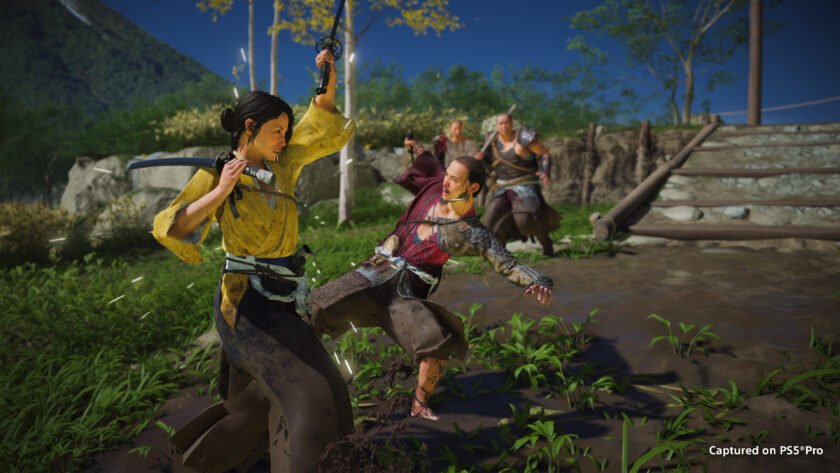
The visual direction is more important than technical spectacle alone. There is a consistency to the presentation that helps Ghost of Yōtei establish its identity, and the environments remain compelling even when the player is doing very little beyond riding through them. It is the sort of world that encourages detours simply because the destination looks interesting.
Combat is equally well presented. Sword strikes, parries and finishing moves have a strong sense of impact, while the animations help communicate the difference between a successful counter and an attack that leaves Atsu vulnerable. The camera can occasionally struggle to keep everything readable when several enemies close in, but the overall presentation gives fights a cinematic quality without sacrificing their immediate physicality.
The expansion’s Ashoro Foothills fit comfortably within this visual framework. They provide another landscape to explore, although they do not completely redefine the game’s environmental design. Players expecting a dramatic visual departure from the main campaign may find the new region familiar, but its presentation remains a pleasure to experience.
Audio is an essential part of Ghost of Yōtei’s atmosphere. The soundtrack complements the changing environments, allowing quieter passages to breathe before the music builds around moments of conflict. That contrast matters because the game is not constantly trying to make every journey feel epic. Silence and restraint can be just as effective as a dramatic musical cue.
The environmental audio also helps bring Ezo to life. The sound of wind moving through vegetation, the ambience of the wilderness and the sharp clash of steel during combat give the world a convincing sense of presence. These details reinforce the difference between travelling through a peaceful landscape and entering a fight where a single mistake can prove costly.
The Japanese setting and samurai-film influences are reflected in the game’s broader presentation, but I appreciate that the atmosphere is not dependent on constant musical bombast. The quieter moments give Atsu’s journey room to breathe, making the transition into combat more effective.
The voice performances contribute to the emotional side of the adventure, particularly when the story focuses on Atsu’s relationships and the experiences that shaped her. Echoes of Sekigahara benefits from this character-driven approach, since its central relationship needs to carry more weight than the straightforward pursuit of another enemy.
Conclusion
Ghost of Yōtei: Complete Edition is a strong package because it recognises what made the original game worth playing and finds two different ways to build on it. Echoes of Sekigahara adds another layer to Atsu’s character, while Most Wanted gives the combat system a more focused and replayable format. Ghost of Yōtei Legends rounds out the package with cooperative multiplayer, and the included cosmetic bonuses make this a more comprehensive release than the original standalone game.
The story expansion is worthwhile, particularly for players who want to understand more about Atsu’s past. Nagato provides a compelling reason to revisit her history, and the flashbacks add context to a protagonist whose identity is shaped by violence and loss. However, the expansion’s familiar mission structure and limited use of flashbacks prevent it from feeling like a major reinvention. It is a good additional chapter, not an entirely new direction for the series.
Most Wanted is the standout addition. By removing the open world’s distractions and focusing on consecutive combat encounters, it allows the game’s swordplay to shine. Its progression systems and unlockable characters give players a reason to keep returning, and it offers a welcome alternative to the main campaign’s longer journeys. For anyone who particularly enjoys Ghost of Yōtei’s combat, this mode alone makes the Complete Edition more attractive.
The main game remains the foundation of the package. Its beautiful landscapes, satisfying swordplay and personal revenge story continue to work well together, even if the open-world activities can become repetitive and the narrative occasionally falls into a predictable rhythm. The Complete Edition does not resolve every weakness, but it gives players more ways to appreciate what the original adventure does best.
For newcomers, this is the most complete way to experience Ghost of Yōtei, bringing together the main campaign, the new story expansion, the survival mode, Legends and the Digital Deluxe content. Returning players have a more specific decision to make. If Atsu’s story is what drew you in, Echoes of Sekigahara is a welcome reason to return. If you primarily enjoyed the combat, Most Wanted is the more compelling addition.
Ultimately, I see Ghost of Yōtei: Complete Edition as a well-judged expansion of an already excellent action-adventure game. It does not transform the original experience, but it strengthens its most appealing qualities and adds meaningful variety. The story expansion could have been more ambitious, and the combat additions are not enough to disguise the familiar structure of the main game, but the overall package remains easy to recommend.
10/10