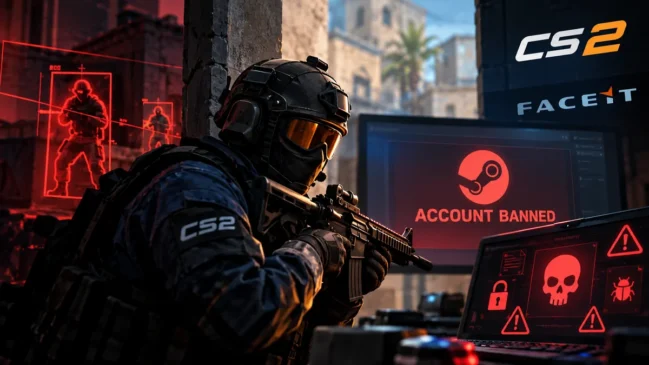
players take avoidable risks and misunderstand how detection and enforcement work. If you are weighing what could go wrong with a CS2 Faceit Cheat, these are the patterns that can cost people their accounts, money, and access to competitive servers.
Treating cheats like a harmless mod
Some players install cheats with the same mindset they bring to crosshair packs or video settings. They assume the worst possible outcome is a short timeout, but cheating software sits in a completely different category.
On official matchmaking, Faceit, and other competitive services, cheating is treated as a direct attack on competitive integrity. Penalties can include long account bans and removal from leagues, hubs, or team play. Creating a second account does not make the underlying conduct safe or consequence-free.
Rage-style play makes the problem obvious. Spinbot behavior and instant-lock aim stand out within seconds to other players and may quickly attract reports or review. There is no gray area in that kind of play, and no setting makes spinning look human.
Cheats are not mods.
They change what everyone else has to deal with in the lobby. A player who tracks opponents through smoke or repeatedly snaps to heads can ruin the match for nine other people. That is why penalties are harsh and appeals may be difficult. Anyone who wants an account that can still queue next month should not treat cheats like crosshairs or viewmodels.
Teams feel the consequences too. A banned player may put tournament results under scrutiny and cause an entire roster to face questions. Even casual stacks often break up once the other players realize someone has been cheating.
Relying on free or public builds
Free and widely shared builds are among the fastest ways to put an account at risk. Once software spreads across public forums, file-sharing sites, and Discord groups, many people can inspect, report, or analyze it. No small developer can reliably control what happens after a build becomes public.
Players still download these files because the offer sounds appealing. There is no upfront payment, and access is immediate. The hidden costs usually appear later.
Those downloads can bring problems beyond a game ban. Repacked loaders may carry password stealers, cryptominers, or other malware alongside the advertised cheat. A player may think they are testing aim assistance for one night, only to wake up to a compromised Steam account or missing items. Even when the advertised features appear to work, that says nothing about what else the file is doing.
Reuse adds another layer of risk. Players sometimes keep an old loader because it appeared to work before, even though game updates, anti-cheat updates, or changes to the software may have made it unsafe or unstable. A quiet session last week is not evidence that the same file is trustworthy today.
Private labeling does not remove the underlying danger, while public releases attract attention by their nature. Once many players run the same software, reports and scrutiny become more likely. Discussions about CS2 Faceit cheat risks repeatedly return to one sound rule: random free downloads should not be trusted.
Buying from anonymous sellers and forum ads
Forum ads and anonymous sellers create a different trap. Prices may look low, while the sales pitch promises undetected status or lifetime access. Buyers generally have no reliable way to verify those claims before sending payment.
The requested payment methods can leave buyers exposed. Sellers often prefer cryptocurrency or gift cards, which can be difficult or impossible to dispute. Once funds are sent, there may be no useful receipt, customer protection, or support.
Some sellers repackage existing software under a different name and market it as private. Renaming a file does not make the underlying program safe, trustworthy, or invisible to a platform’s security systems. Buyers may pay a premium for what they believe is exclusive software and receive a recycled build that puts both their computer and account at risk.
Straightforward scams add to the loss. Some sellers take payment without providing a working product, while others distribute malware designed to steal credentials or session data. The relevant issue is that claims made by cheat sellers should not be confused with independent evidence.
Expensive products also rely on false confidence. Sellers may present specialist hardware or complicated setups as proof of safety, but cost does not remove account, security, or reputational risks. The bill rises while the core problem remains.
Thinking a fresh account fixes a ban
A fresh Steam account does not erase a previous ban or guarantee access to third-party services. Platforms may use several signals when applying their rules, and attempting to return after a ban can lead to further enforcement under their terms.
Players often learn this after spending more money. They create another account, buy access or cosmetic items, and return to the same behavior. The cycle repeats because changing a username does not change the reason the original account was penalized.
Trust and reputation systems add another concern. Valve and third-party platforms can consider account history and behavior when deciding matchmaking quality or access. Cheating reports and penalties can make it harder to establish a credible new account. Starting again is not the same as restoring trust.
Inventories raise the financial stakes. Items associated with an account may become difficult or impossible to use normally if account restrictions apply, depending on the type of enforcement. Appeals do not guarantee restored access, so players can put years of trading and collecting at risk with one decision.
Tools marketed as ban fixes create another purchase without solving the underlying issue. They commonly require extensive system permissions and may introduce crashes, malware, privacy problems, or additional rule violations. Paying for another tool can turn one loss into several.
Misunderstanding how detection actually works
Many players assume detection is only about files stored on a computer. That view is too narrow. Competitive platforms can use multiple forms of technical monitoring, player reports, match data, and manual investigation. Ignoring that broader picture leads to false confidence.
File scans are only part of it
Anti-cheat systems may look for known software traces or suspicious interaction with a protected game. The exact methods vary by platform and change over time, which is one reason confident claims about a particular build being “undetected” should be treated skeptically. Players usually cannot verify what the seller says about current detection.
Commercial CS2 cheat services such as HardHax operate in a technical environment that can change with game and anti-cheat updates, so availability alone is not proof that a particular build will remain undetected.
Outdated builds are especially unreliable. A loader that seemed to function before may stop working after a game, operating system, or anti-cheat update. Players often blame bad luck when the more basic problem is that they trusted old, unauthorized software whose behavior they could not inspect or control.
Behavior and replays close the gap
Visual assistance creates evidence in the match itself. Replays and match footage can reveal suspicious decisions that a file check alone may not explain. Information about enemy positions changes how someone clears angles, while aim assistance can produce unnatural crosshair movement. Reviewers do not always need access to the original program when repeated play patterns raise serious concerns.
Platform investigations can also draw on player reports, clips, match data, and other available records. Perfect crosshair placement round after round or repeated reactions to information a player should not have may look wrong to experienced observers. Reports accumulate quickly when teammates and opponents notice the same moments. A convincing pattern can put an account at risk even when the user assumes the software itself left no obvious trace.
Aggressive settings make suspicious play easier to notice. Repeated snaps, improbable accuracy, and pre-fires without visible information can stand out within a short match. Human aim naturally includes missed shots, corrections, and inconsistent reactions.
Those ordinary errors help distinguish legitimate play from automation. Real players misread audio, clear the wrong angle, and mistime shots. Cheat-assisted accounts may show fewer natural gaps, and the difference becomes easier to notice across a full recording.
Ignoring malware, privacy and money risks
Cheat loaders often request extensive access to a computer. They may ask for administrator permissions or installation of low-level components so they can interfere with the game. A malicious build can use that access to take far more than game data, including passwords and session tokens. There is no practical refund process when a free download compromises an inventory.
Paid scams rely on similar promises. Anonymous shops advertise private access and instant delivery, yet what arrives may be recycled software, a broken download, or nothing at all. Recovering the payment can be difficult when it was sent through cryptocurrency or gift cards.
The privacy damage can last longer than an account penalty. Untrusted software may collect hardware information, account details, browsing data, or other personal information. System stability also becomes a cost, since unauthorized tools can conflict with game or Windows updates and cause repeated crashes. The total expense can exceed the advertised price.
Players who purchase additional computers, devices, or software to support cheating spend more while retaining the same basic risks. Expensive equipment cannot protect an account from suspicious behavior, reports, scams, or malware. The math does not favor the buyer.
Driver instability adds technical problems on top of possible enforcement. Fragile tools may break after routine updates to the game or operating system, leading to crashes and corrupted files. Players may blame the latest patch when the unauthorized software was the weak point all along.
Overlooking reputation damage and better ways to improve
Bans can follow players beyond one account. Faceit penalties may block access to league hubs or team tryouts, while former teammates may no longer trust someone who was caught cheating. Screenshots of ban notices can circulate through Discord groups and local communities. Rebuilding a damaged reputation takes far longer than improving aim.
There are safer ways to climb without risking hardware, money, or account access. Regular aim training builds mouse control without unnatural snaps. Demo review exposes positioning mistakes that lead to avoidable deaths, while coaching can identify habits that solo queue does not make obvious. Sensitivity and crosshair adjustments can also provide cleaner feedback without unauthorized software.
These approaches work together because each addresses a different weakness. Aim practice improves control, demo review helps with rotations and decision-making, and a coach can spot recurring crosshair or positioning errors. Well-chosen settings reduce distractions. Progress is slower than flipping a toggle, but the improvement remains useful and legitimate.
Demo habits compound over time. A short review after a couple of matches can teach more than repeatedly queuing on autopilot. Players begin to see why retakes fail, where positioning breaks down, and when utility is wasted. Those lessons remain useful across maps and seasons.
The best accounts stay valuable because they stay clean. Avoiding unknown loaders and intrusive drivers protects the computer as well as the game account. Consistent practice and review provide the improvement, while a clean record preserves access to better hubs, reliable teammates, and the inventory attached to the account.
Every shortcut carries a similar bill: lost access, wasted money, damaged trust, or a compromised computer. Clean play ensures that earned progress is not undone by an enforcement action. It is the only approach that remains dependable over time, so keep both the account and the setup clean.