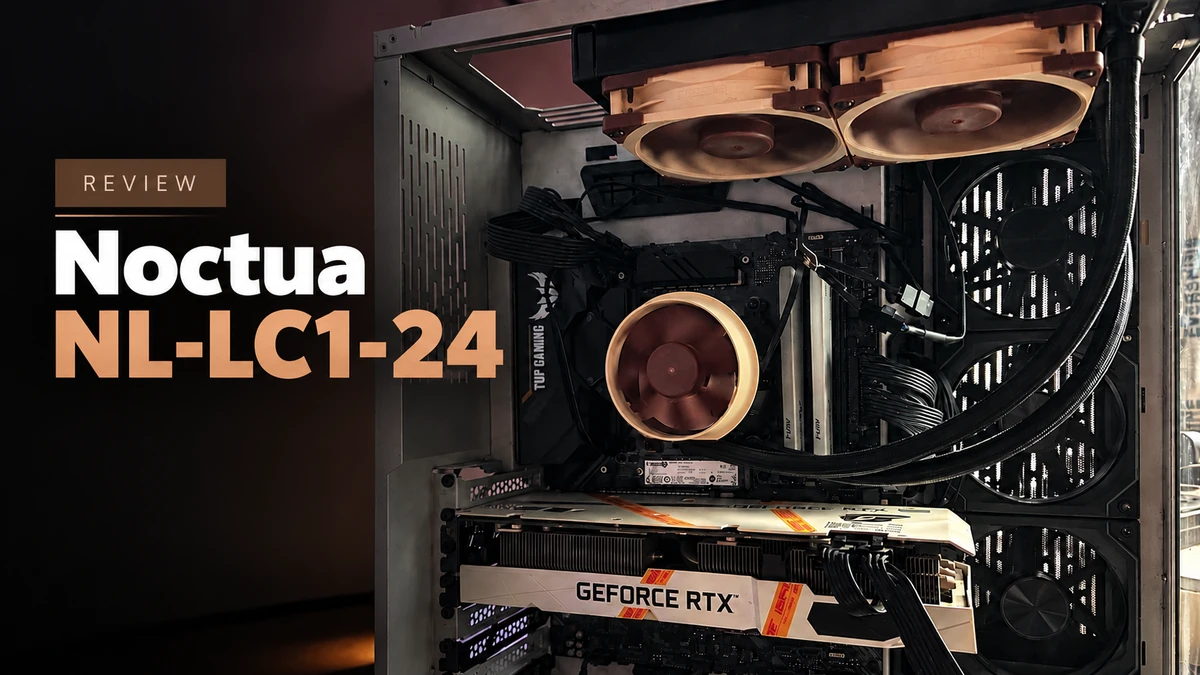
Noctua is best known for its air coolers and fans, but the NL-LC1-24 brings the company into the all-in-one liquid-cooling market. We put this premium 240mm AIO through a series of thermal tests to see how it performs against a familiar 240mm cooler, including one fitted with Noctua’s own fans.
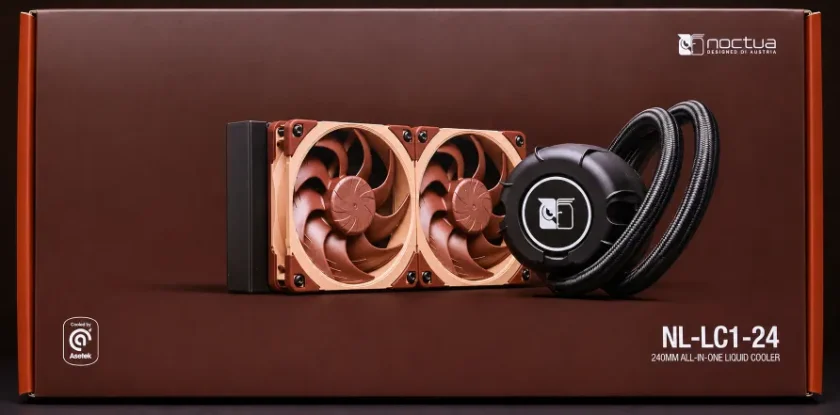
Noctua Enters the AIO Market
Noctua has spent years building a reputation around high-performance cooling, particularly its air coolers and fans. The NL-LC1-24 represents a significant expansion of that portfolio: a 240mm all-in-one liquid cooler built around an Asetek Emma V2 platform and supplied with two NF-A12x25 G2 PWM fans.
That combination makes the NL-LC1-24 interesting from the outset. Rather than simply putting its name on a conventional liquid cooler, Noctua brings its own fan hardware, mounting system and pump-noise-reduction design to the package.
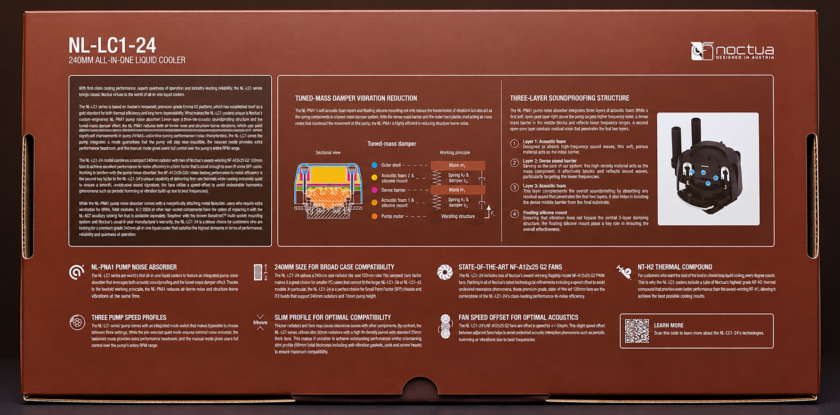
Of course, a premium cooler has to do more than look promising on paper. We tested the NL-LC1-24 against a DeepCool LE240 V2, first with its original fans and then with a pair of Noctua NF-A12x25 G2 fans. This lets us examine both the performance of the complete Noctua cooler and the contribution made by its fans.
Our results put the NL-LC1-24 firmly in contention for enthusiasts considering a high-end 240mm AIO.
Specifications and Features
The Noctua NL-LC1-24 combines a 240mm aluminium radiator with a copper cold plate, two NF-A12x25 G2 PWM fans and an Asetek Emma V2 pump platform.
Key specifications include:
| Specification | Noctua NL-LC1-24 |
|---|---|
| Cooler type | All-in-one liquid CPU cooler |
| Radiator size | 240mm |
| Radiator dimensions | 279.5 × 120 × 30mm |
| Radiator material | Aluminium |
| Cold plate material | Copper |
| Fans | 2 × Noctua NF-A12x25 G2 PWM |
| Tubing | 400mm braided EPDM |
| Pump platform | Asetek Emma V2 |
| Pump control | Quiet, Balanced and Manual profiles |
| Manual pump speed | Up to 3400 RPM |
| Thermal compound | Noctua NT-H2 |
| CPU compatibility | AMD AM4/AM5; supported Intel LGA platforms |
| Mounting system | Noctua SecuFirm2+ |
| Warranty | Six years |
The radiator measures 30mm thick before accounting for the fans. With the fans installed, the combined radiator-and-fan thickness is approximately 59mm, so builders should check radiator clearance against their case and motherboard layout.
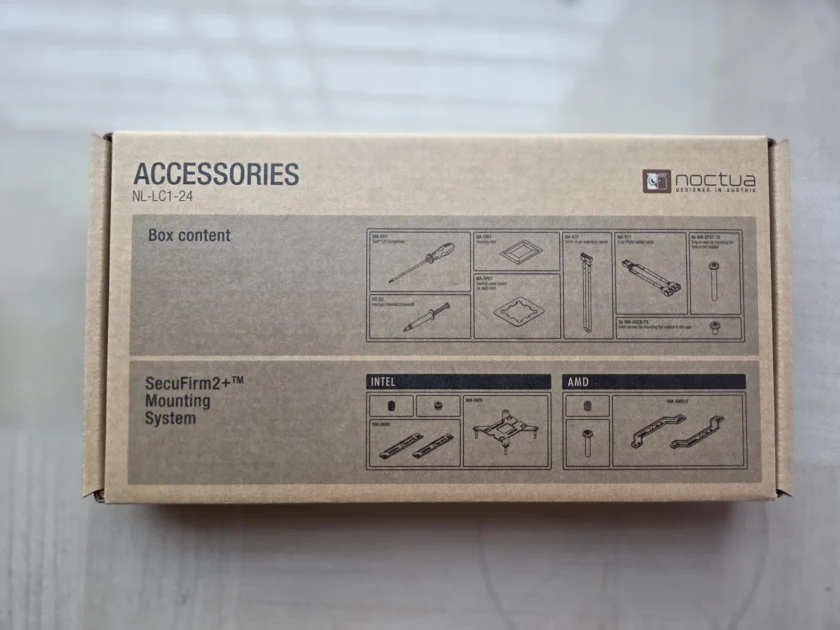
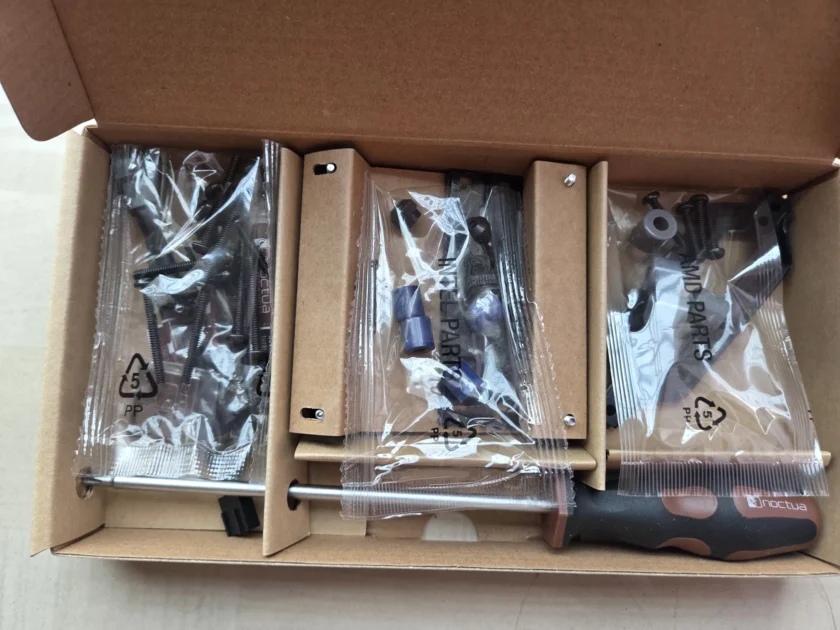
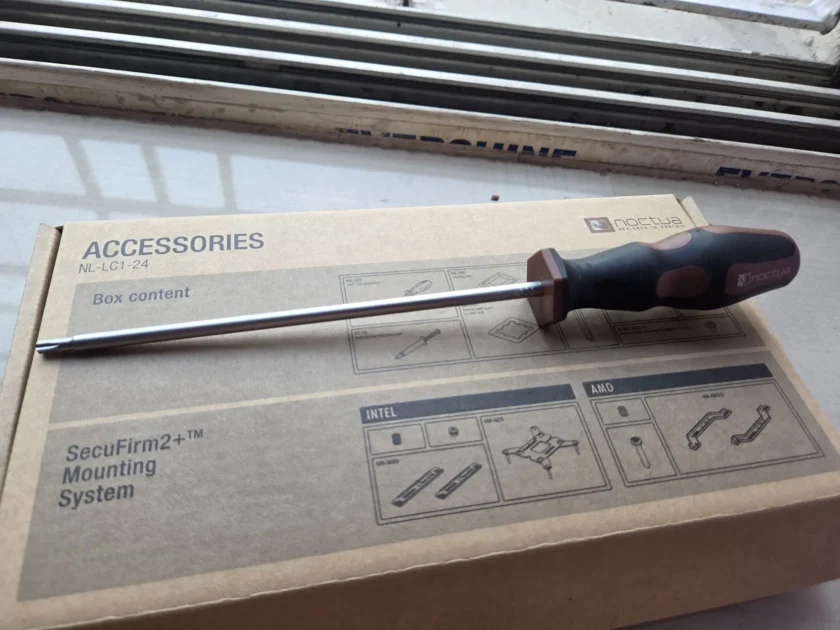
The cooler uses 400mm braided EPDM tubing. Noctua also supplies its NT-H2 thermal compound and SecuFirm2+ mounting hardware.
Design and Build
The NL-LC1-24 follows a relatively restrained design philosophy. Its appeal is less about RGB lighting or elaborate visual effects and more about the cooling hardware, installation system and supporting features.
The 240mm radiator uses an aluminium construction, while the cold plate is copper. The tubing is braided and measures 400mm, providing some flexibility when routing it between the CPU block and radiator.
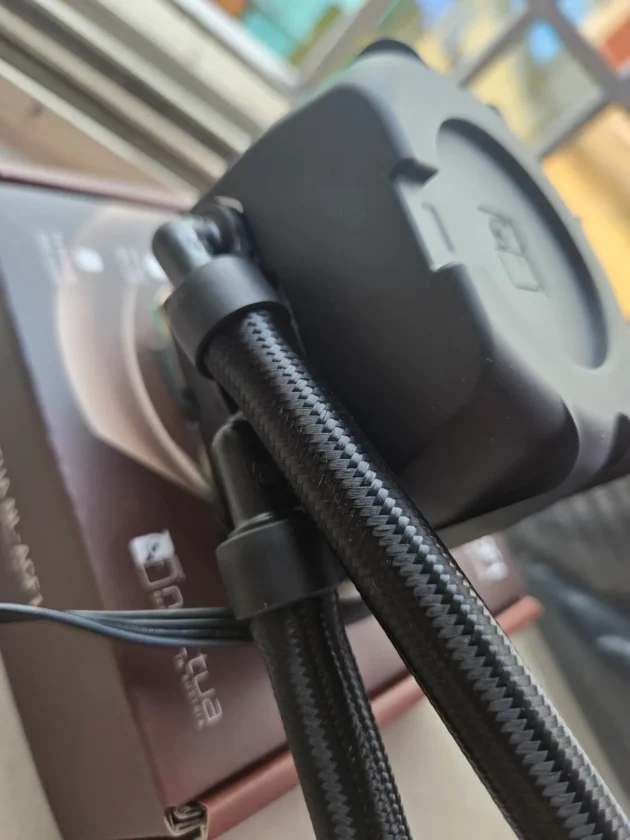
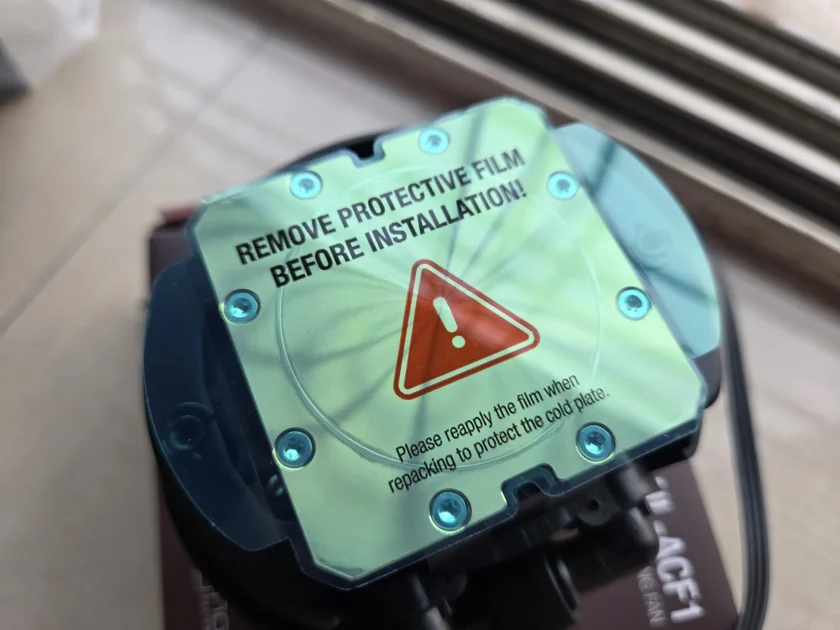
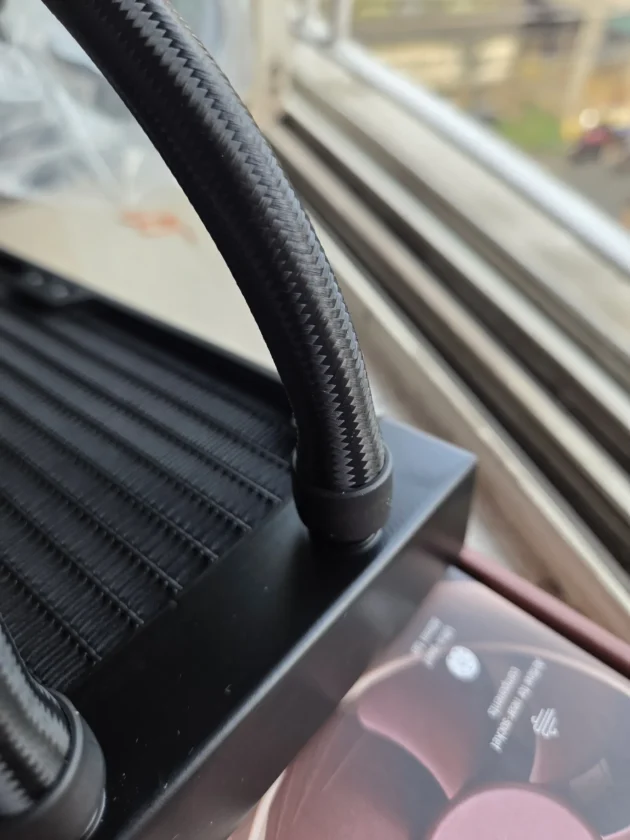
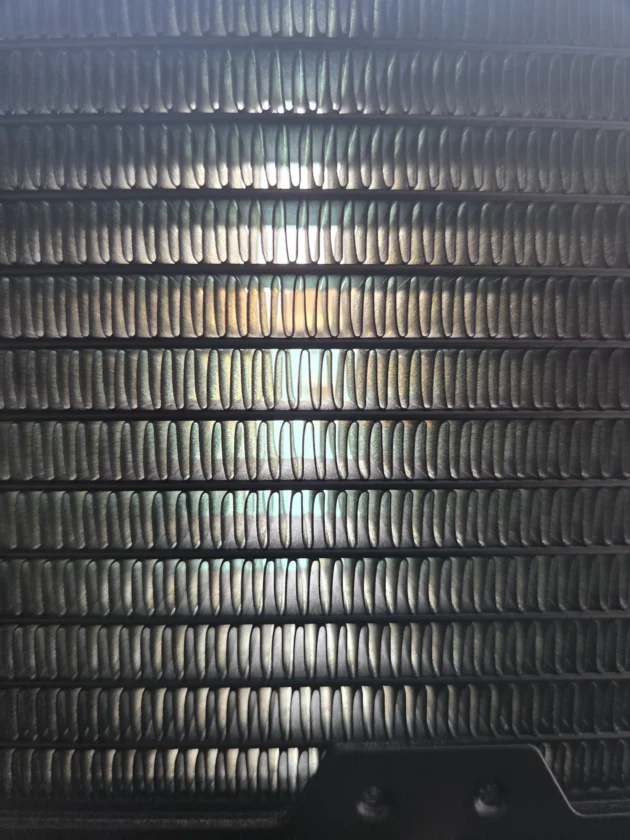
The pump assembly incorporates Noctua’s approach to noise management, while the supplied fans are the company’s NF-A12x25 G2 PWM models. The result is a package that places cooling hardware at the centre of the product’s identity.
That approach should appeal to builders who want a premium cooler without making lighting or visual customisation the primary consideration.
The NF-A12x25 G2 Fans
The included NF-A12x25 G2 PWM fans are an important part of the NL-LC1-24’s proposition. Noctua has established its reputation in large part through its fan engineering, and supplying these fans with the cooler gives buyers more than a generic pair of radiator fans.
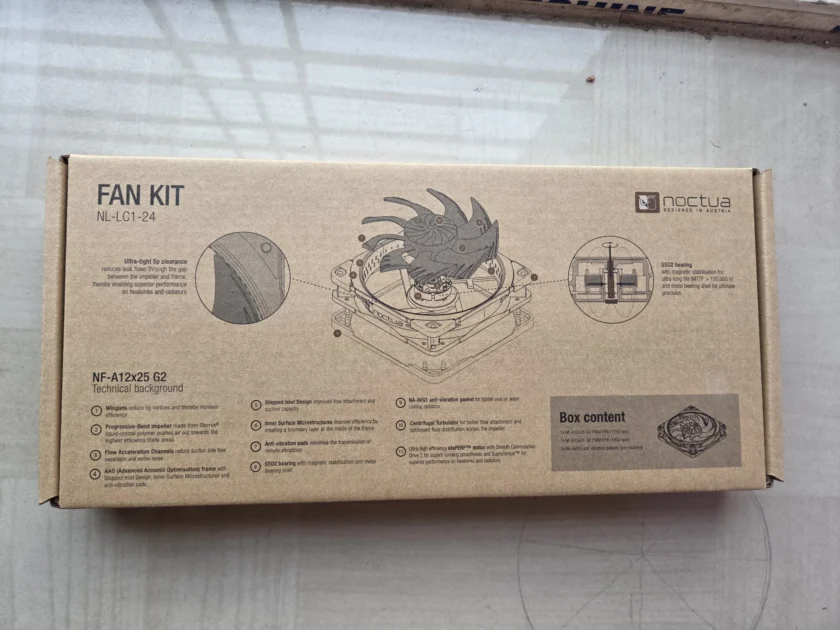
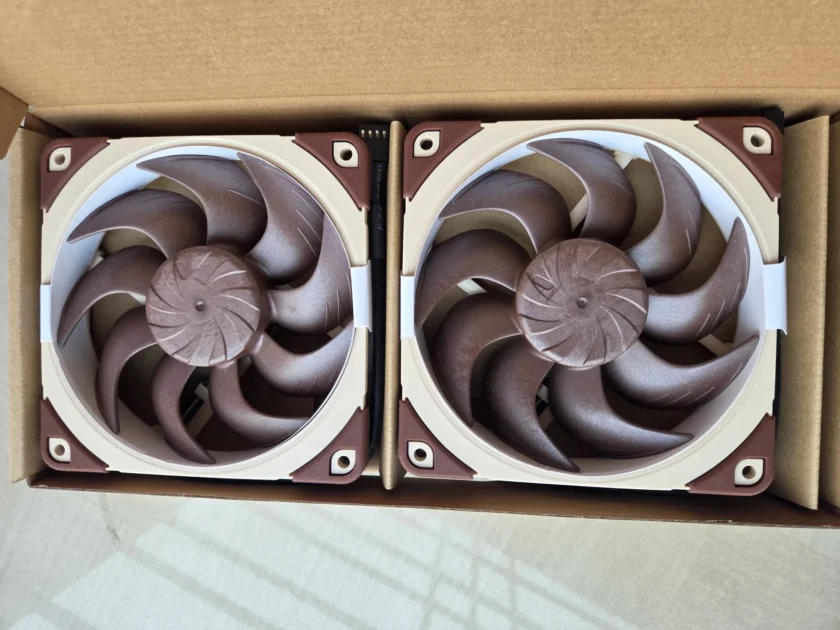
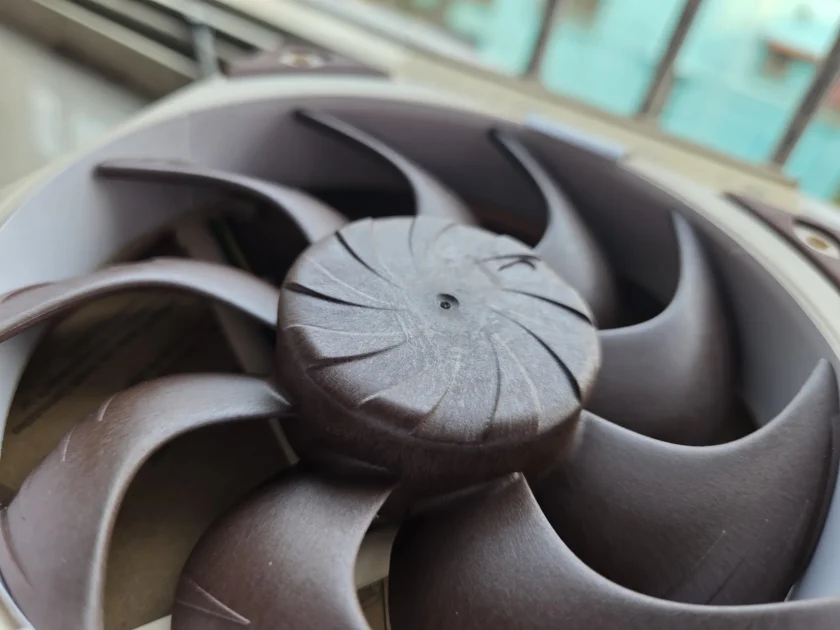
We also used the NF-A12x25 G2 fans on the DeepCool LE240 V2 during our testing. That additional configuration helps separate the effect of changing the fans from the performance of the complete Noctua AIO.
The results show that changing the fans improved the DeepCool cooler’s thermal performance, but the NL-LC1-24 still delivered the lowest temperatures in our tests.
That distinction matters. The fans contribute to the result, but the performance we recorded belongs to the complete cooling package rather than the fans alone.
Emma V2 Platform and Pump
The Noctua NL-LC1-24 is built around Asetek’s Emma V2 liquid-cooling platform, a design that goes beyond simply increasing pump speed. Asetek’s technical documentation describes changes to the impeller, motor, internal coolant paths and cold plate, with the aim of improving hydraulic performance, efficiency and acoustics.
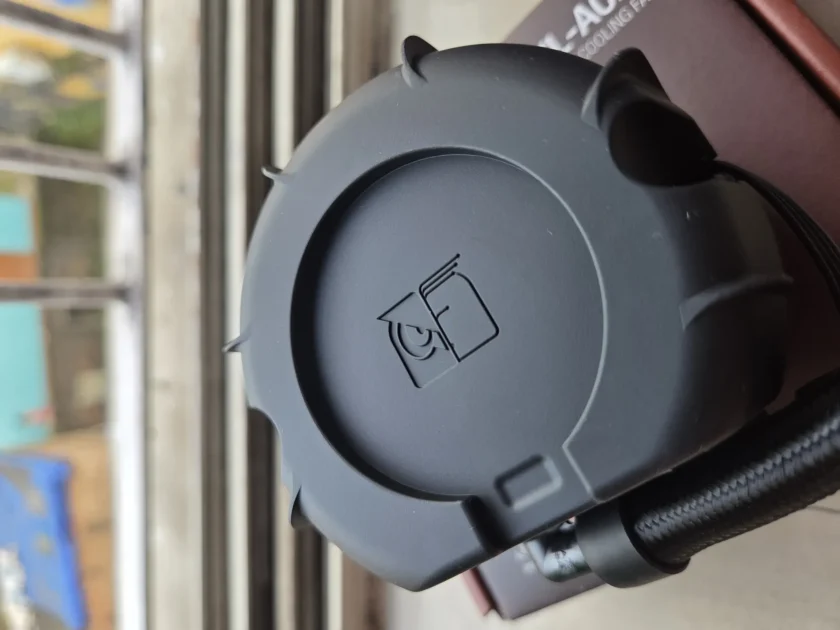
The pump uses a closed centrifugal impeller driven by a three-phase, 12-pole motor. Asetek says the closed impeller improves efficiency and performance stability compared with earlier open or semi-closed designs. It has also refined the placement of the impeller’s balancing holes to reduce axial forces and optimised the motor’s control behaviour to improve running smoothness.
Asetek reports substantial flow-rate and head-pressure improvements over its older Sigrid V2 platform at the same noise level. These are manufacturer-reported platform comparisons, not measurements from our test system, and they should not be interpreted as equivalent percentage improvements in CPU cooling performance.
The hydraulic design extends to the internal coolant paths and cold plate. Asetek describes smoother, carefully shaped flow channels intended to reduce resistance and unnecessary turbulence, alongside a high-purity copper cold plate with skived microfins. An integrated injection plate helps distribute coolant across the fin array.
The pump offers Quiet, Balanced and Manual profiles, with maximum specified speeds of 2,100, 2,600 and 3,400 RPM respectively. The NL-LC1-24 also incorporates Noctua’s NL-PNA1 pump noise absorber, which combines a three-layer acoustic structure with a tuned-mass-damper approach intended to reduce airborne noise and structure-borne vibration.
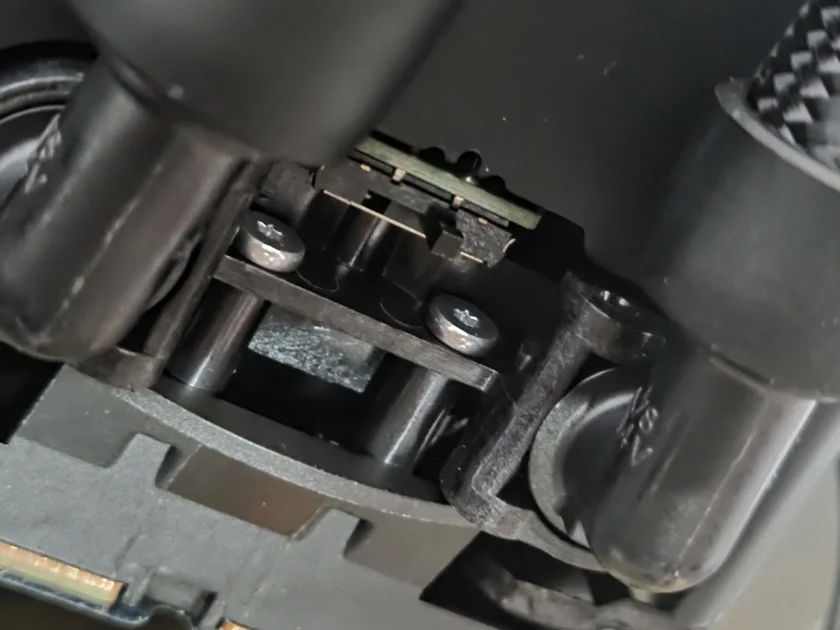
This is where Noctua’s implementation becomes particularly interesting. The cooler combines Asetek’s underlying pump technology with Noctua’s acoustic treatment, NF-A12x25 G2 fans and SecuFirm2+ mounting system. Asetek’s Emma Gen8 V2 platform also appears in the ROG Ryujin III 360 ARGB Extreme, so the platform itself is not exclusive to Noctua. The finished products, however, differ in their overall implementation.
We did not dismantle the pump or measure its acoustic output using a calibrated sound-level meter. Our conclusions therefore rest on the thermal results obtained from the complete cooler, rather than attributing its performance to any single internal component.
Test System and Methodology
We tested the NL-LC1-24 on our existing test system, using the DeepCool LE240 V2 as the comparison cooler which is our daily driver.
Test System
| Component | Specification |
|---|---|
| Processor | AMD Ryzen 5 5600 |
| CPU settings | Stock |
| Motherboard | ASUS TUF Gaming X570-PLUS |
| Graphics card | NVIDIA GeForce RTX 3050 8GB |
| Memory | 16GB DDR4 |
| Case | Lian Li O11 Dynamic |
| Operating system | Windows 11 |
| Workload | Cinebench 2024.1.0 CPU Multi Core |
| Monitoring | HWiNFO64 sensor logging |
| Ambient temperature | 32°C |
The tests were conducted with the case side panel removed and the air conditioner switched off. Ambient temperature was recorded at 32°C.
We used HWiNFO64 to log the CPU Package temperature during the Cinebench 2024.1.0 CPU Multi Core workload. Our primary metric was the recorded CPU Package temperature, rather than the Cinebench score.
We tested three configurations:
- DeepCool LE240 V2 with its stock fans.
- DeepCool LE240 V2 fitted with Noctua NF-A12x25 G2 fans.
- Noctua NL-LC1-24 with its supplied NF-A12x25 G2 fans.
Each configuration was tested three times, giving us nine runs in total.
Each cooler was tested with the thermal compound supplied or pre-applied as part of its respective package. The DeepCool cooler used its factory-applied thermal compound, while the Noctua cooler used Noctua NT-H2. This was an out-of-the-box package comparison, not a controlled test of the thermal compounds themselves.
All three configurations were tested on the same platform, using the same workload and CPU settings. The results therefore provide a useful comparison under our test conditions, although they should not be treated as a universal ranking for every processor, case or ambient temperature.
Thermal Performance: The Results
The NL-LC1-24 delivered the lowest average peak CPU Package temperature in all three configurations we tested.
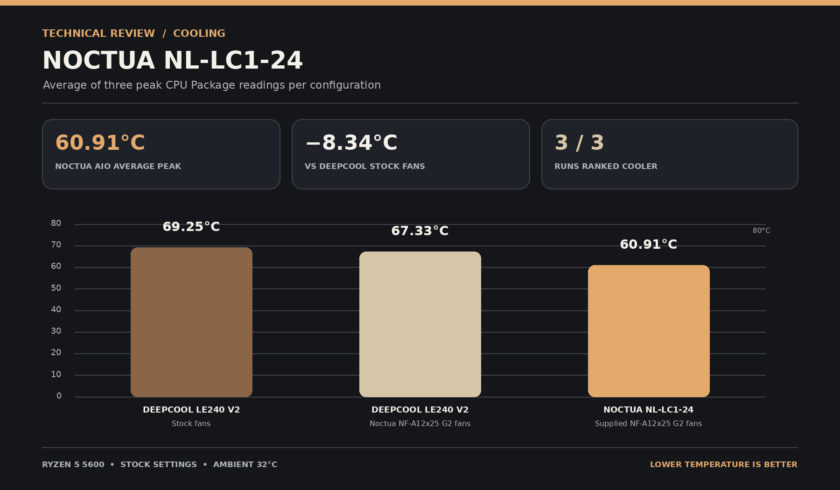
Average Peak CPU Package Temperature
| Cooler configuration | Run 1 | Run 2 | Run 3 | Average peak |
|---|---|---|---|---|
| DeepCool LE240 V2 + stock fans | 69.00°C | 68.75°C | 69.99°C | 69.25°C |
| DeepCool LE240 V2 + Noctua NF-A12x25 G2 fans | 67.37°C | 66.90°C | 67.71°C | 67.33°C |
| Noctua NL-LC1-24 + Noctua NF-A12x25 G2 fans | 60.99°C | 60.50°C | 61.23°C | 60.91°C |
Lower temperatures are better. Results are from our test system under the conditions described in the methodology.
The difference is substantial. The NL-LC1-24 recorded an average peak CPU Package temperature of 60.91°C, compared with 69.25°C for the DeepCool LE240 V2 with its stock fans.
That is an 8.34°C reduction in average peak temperature.
Replacing the DeepCool cooler’s stock fans with the Noctua NF-A12x25 G2 fans improved its average peak temperature from 69.25°C to 67.33°C, a reduction of 1.92°C. This confirms that the fan change made a measurable difference in our test.
However, the DeepCool cooler with the Noctua fans still recorded an average peak of 67.33°C. The complete NL-LC1-24 configuration reached 60.91°C, putting it another 6.42°C lower.
The result is worth highlighting because the comparison does not rely solely on the DeepCool cooler’s original fans. Even after fitting the same model of Noctua fan used by the NL-LC1-24, the DeepCool configuration remained behind in our testing.
The result supports the NL-LC1-24 as a strong thermal performer on our test bench.
Peak Temperatures Versus Mean Temperatures
Peak temperature is useful for identifying the highest recorded CPU Package reading during a run, but it does not tell the whole story. Looking at the mean temperature across each run provides another way to compare the configurations.
| Cooler configuration | Mean temperature across run means |
|---|---|
| DeepCool LE240 V2 + stock fans | 67.80°C |
| DeepCool LE240 V2 + Noctua NF-A12x25 G2 fans | 65.56°C |
| Noctua NL-LC1-24 + supplied fans | 58.83°C |
The NL-LC1-24 also recorded the lowest mean temperature, at 58.83°C. That was 8.97°C lower than the DeepCool cooler with its stock fans and 6.73°C lower than the DeepCool cooler fitted with Noctua fans.
This is important because the difference was not limited to a single peak reading. The Noctua configuration maintained the lowest temperatures across the recorded workload.
The spread between the highest and lowest peak readings across the three runs was also relatively small for all configurations:
| Cooler configuration | Peak-temperature range across three runs |
|---|---|
| DeepCool LE240 V2 + stock fans | 1.24°C |
| DeepCool LE240 V2 + Noctua NF-A12x25 G2 fans | 0.81°C |
| Noctua NL-LC1-24 + supplied fans | 0.73°C |
The NL-LC1-24’s peak readings varied by just 0.73°C across the three runs. The ranking remained consistent in every run, with the Noctua AIO recording the lowest peak temperature each time.
These findings make the thermal result more convincing than a single isolated run would have been. They do not establish how the cooler would rank against every competing AIO, but they demonstrate consistent performance in our test environment.
Installation and Compatibility
The NL-LC1-24 uses Noctua’s SecuFirm2+ mounting system and supports compatible AMD and Intel desktop platforms. Buyers should check the official compatibility list before purchasing, particularly when planning a new build or upgrading an existing system.
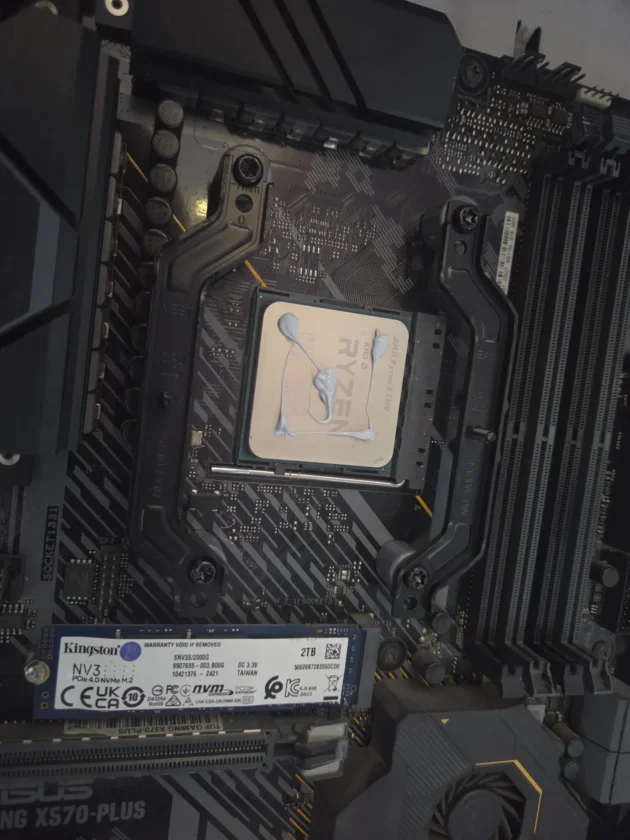
The radiator’s 30mm thickness and the combined thickness of approximately 59mm with fans installed are also worth considering. A 240mm radiator may fit a case that cannot accommodate a 360mm unit, but radiator length alone does not guarantee compatibility. The available clearance around the motherboard, memory, top panel and other components matters too.
The 400mm tubing provides routing flexibility, although the final installation will depend on radiator placement and case layout.
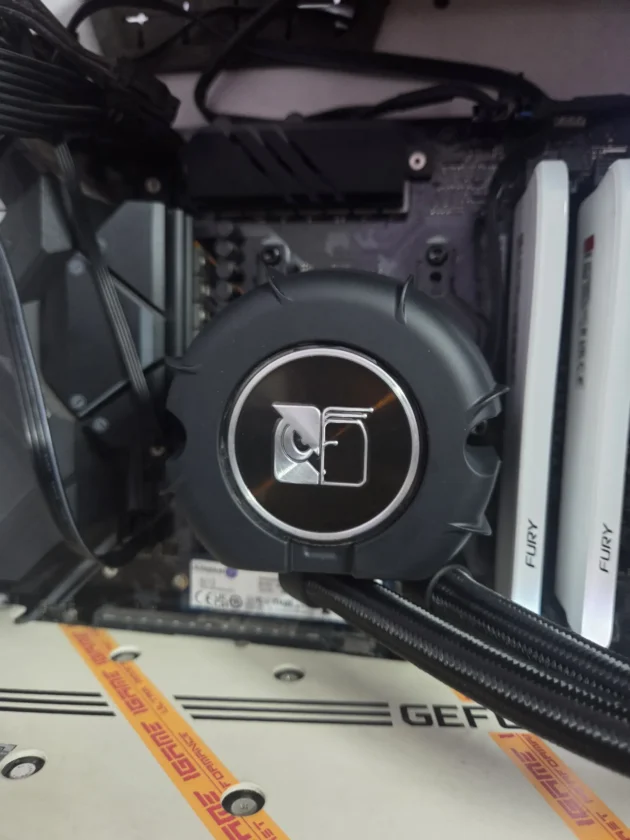
For anyone building in a compact or tightly configured chassis, it is worth checking the case manufacturer’s radiator-clearance specifications before committing to the cooler.
Noise and Acoustic Considerations
Noise is an important part of any premium cooling product’s overall performance. A cooler that delivers low temperatures but produces excessive pump or fan noise may not be the right choice for every system.
Noctua has addressed this area through the supplied NF-A12x25 G2 fans, pump operating profiles and the NL-PNA1 pump noise absorber. The latter is designed to reduce airborne noise and structure-borne vibration.
Those are meaningful features, but our acoustic assessment remains qualitative. We did not use a calibrated sound-level meter to measure the cooler’s sound output under controlled conditions, so we cannot provide a reliable dBA figure or claim a measured acoustic advantage over the DeepCool configurations.
We therefore judge the NL-LC1-24 primarily on the thermal results recorded in this review. Its acoustic design is part of the package, but a quantified comparison of noise levels would require a dedicated measurement setup.
Price and Value
The NL-LC1-24 occupies the premium end of the 240mm AIO category. Its proposition includes Noctua’s NF-A12x25 G2 fans, NT-H2 thermal compound, SecuFirm2+ mounting system, pump-noise-reduction hardware and six-year warranty.
Our thermal results give the cooler a strong starting point. It outperformed both DeepCool configurations in our testing, including the one fitted with Noctua’s own fans.
However, we could not establish a reliable current Indian retail price for the NL-LC1-24. We therefore cannot give a responsible price-to-performance verdict or declare it better value than competing coolers at a specific selling price.
That does not diminish what the cooler achieved on our test bench. It means that buyers should confirm local availability, warranty terms and the final selling price before making a purchase decision.
Verdict

The Noctua NL-LC1-24 has earned its place on the shortlist for anyone building a high-end PC with a 240mm liquid cooler. In our testing, it delivered an average peak CPU Package temperature of 60.91°C : 8.34°C lower than the DeepCool LE240 V2 with its stock fans, and 6.42°C lower than the same DeepCool cooler fitted with Noctua NF-A12x25 G2 fans. The result held across all three runs, and the NL-LC1-24 also recorded the lowest mean temperature.
That is a convincing thermal showing on our test bench. It gives us a sound reason to recommend the NL-LC1-24 to enthusiasts who prioritise cooling performance and want a premium 240mm package.
The other part of the proposition is Noctua itself. The company brings an established reputation in cooling, its NF-A12x25 G2 fans, a dedicated pump noise absorber and its SecuFirm2+ mounting system to the product. The underlying Asetek Emma V2 platform is not unique to Noctua, ASUS also uses an Emma Gen8 V2 platform in the ROG Ryujin III 360 ARGB Extreme; but Noctua’s implementation is what we are reviewing here.
We have not measured acoustics with a calibrated sound-level meter, so we will not pretend to have quantified a noise advantage. Nor could we establish a reliable current Indian retail price, which means we cannot responsibly attach a price-to-performance verdict. Those are limitations to the scope of our assessment, not reasons to dismiss the product.
Our verdict: Recommended for consideration in the high-end 240mm AIO segment. The NL-LC1-24 combines excellent results in our thermal testing with a thoughtfully equipped package from an established cooling brand. If you’re shopping at the premium end of the market and want a 240mm AIO, Noctua’s fan hardware and the results we recorded make this one worth serious consideration. Check local availability and pricing before buying, but don’t overlook it simply because Noctua is better known for air coolers.